On this page
How much MOTS-C do people report taking, and for how long?
The reports reviewed here include 1 mg daily, 1–2 mg three times a week, and 5 mg twice a week. Reported blocks run from about five weeks to seven weeks, including a 40-day daily routine. The table puts the amount, frequency and duration together so each schedule is easy to read.
| Amount each time | How often | Reported length | Per week | Calculated quantity |
|---|---|---|---|---|
| 1–2 mg | 3 times a week | About 5 weeks [3] | 3–6 mg | 15–30 mg over 5 weeks |
| 1 mg | Daily | 40 days [5] | 7 mg | 40 mg over 40 days |
| 5 mg | Twice a week | 7 weeks [6] | 10 mg | 70 mg over 7 weeks |
| About 3.33 mg | 3 times a week | Second cycle; length unspecified [5] | About 10 mg | Depends on the number of weeks |
| 5 mg | Twice a week | 4 administrations described [4] | 10 mg | 20 mg across those 4 administrations |
These are selected public reports, not a clinically validated dosing protocol or an individual recommendation. Calculated totals describe a fixed schedule’s quantity, rather than verified consumption or shelf life.
What effects and other compounds were reported with these schedules?
The five-week author described a modest cardio improvement with 1–2 mg three times weekly and also disclosed NAD+ use. A trial of 3 mg three times weekly added little perceived effect. [3]
The 40-day author described a leaner appearance with 1 mg daily, without a clear energy change, and alternated courses with SS-31. Another commenter reported better energy at about 3.33 mg three times weekly after fatigue at 5 mg three times weekly. [5]
The seven-week comment described two people using 5 mg twice weekly, with no perceived benefit and mild local reactions; prior SS-31 use was disclosed. A separate twice-weekly account described early energy and motivation, then soreness and feeling unwell after later administrations, alongside several other compounds. [4] [6]
These accounts are not customer reviews of the products on this website. Their results belong with their individual circumstances.
Buy MOTS-C: 10 mg, 40 mg or a preloaded pen
Choose from 10 mg and 40 mg MOTS-C vials or a preloaded 30 mg / 3 mL autoinjector. Compare the format and labelled quantity, open the original vial reports, and select your product below.
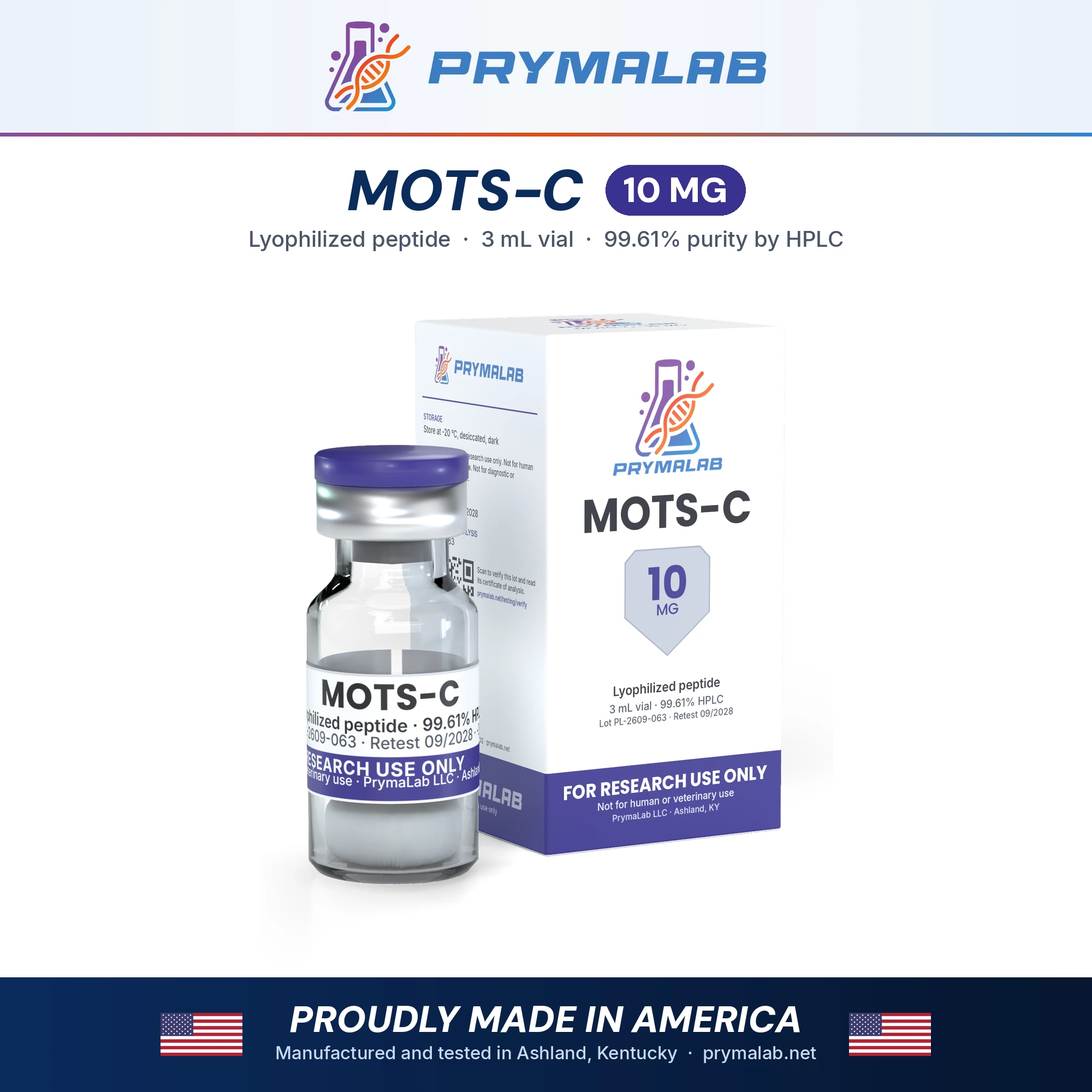
MOTS-C 10 mg
A 10 mg freeze-dried vial for measured laboratory preparations.
- Peptide per vial
- 10 mg
- Form
- Dry powder
- Reported HPLC purity
- 99.61%
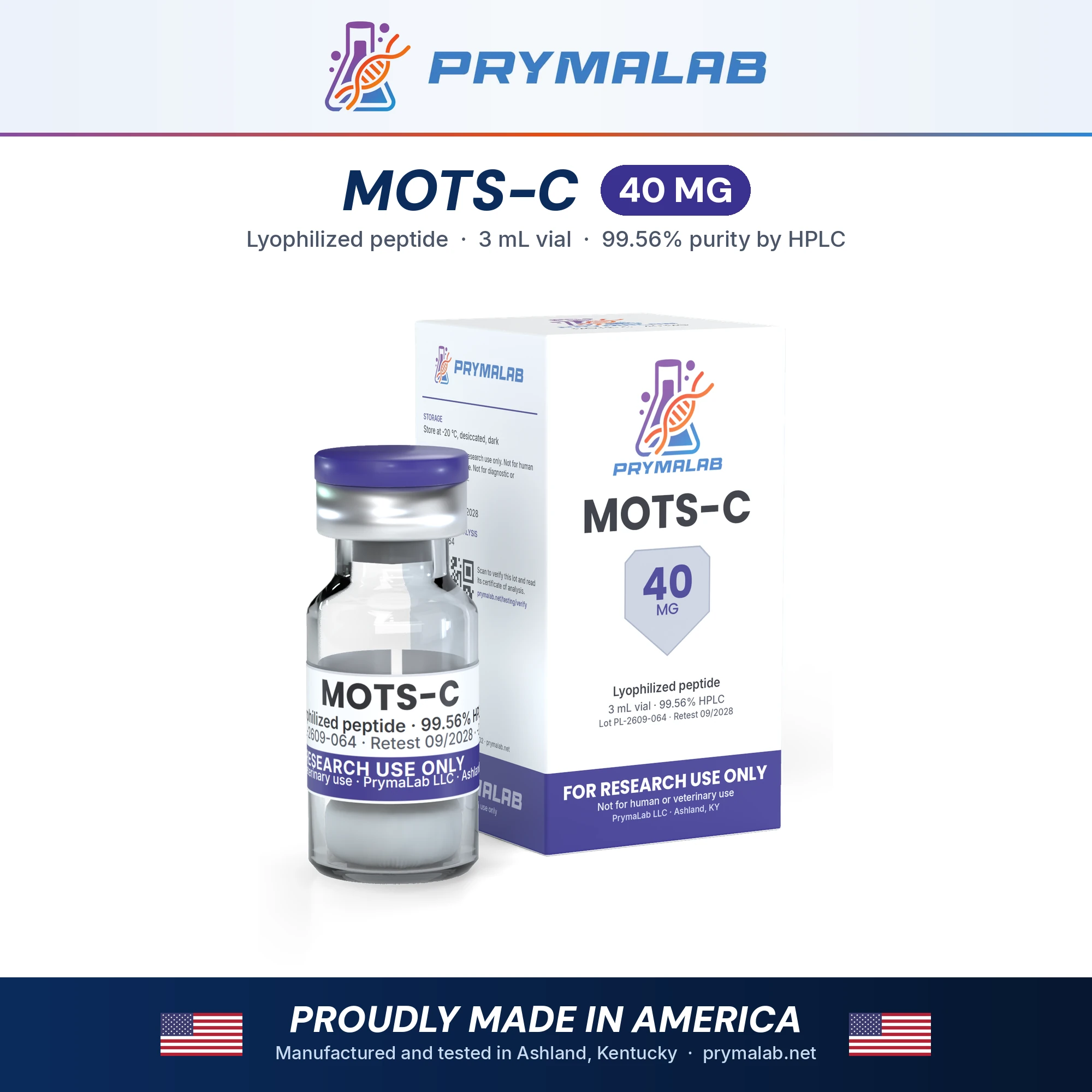
MOTS-C 40 mg
Four times the peptide per vial in the same freeze-dried format.
- Peptide per vial
- 40 mg
- Form
- Dry powder
- Reported HPLC purity
- 99.56%
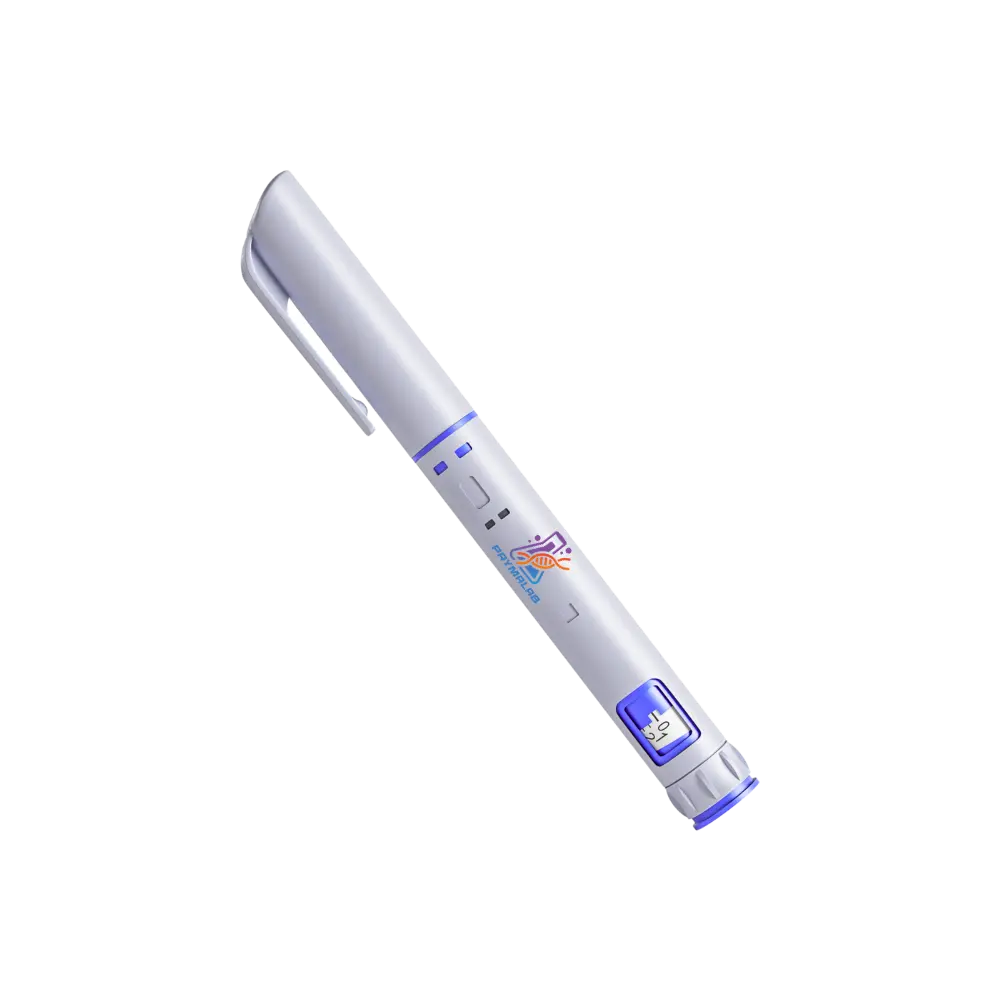
MOTS-C 30 mg pen
Preloaded at 10 mg/mL, with no powder reconstitution.
- Peptide per pen
- 30 mg
- Solution volume
- 3 mL
- Concentration
- 10 mg/mL
Research-use products. Vial purity figures are reported in the original in-house COAs below. Ordering is not yet available on this website.
Is the 40 mg vial stronger than the 10 mg vial?
It contains four times as much peptide in total. The concentration of a prepared solution also depends on its final liquid volume. Compare the concentration charts before treating milligrams per vial as milligrams per measured volume.
What is the difference between MOTS-C per day and per week?
Amount each time × number of administrations = total quantity. A label such as “5 mg twice weekly” contains two pieces of information: 5 mg each time, on two occasions during the week.
| Written schedule | Calculation | Weekly total |
|---|---|---|
| 1 mg daily | 1 mg × 7 | 7 mg |
| 2 mg, 3 times weekly | 2 mg × 3 | 6 mg |
| 5 mg, twice weekly | 5 mg × 2 | 10 mg |
How should you read a 10 mg weekly total?
Look back at the original frequency. In the twice-weekly report, 10 mg means two separate 5 mg amounts. Dividing 10 mg by seven produces a daily average, but it changes the description of the actual routine. Keep the amount and frequency together whenever comparing charts.
For a 40-day daily account, count 40 administrations. For a seven-week twice-weekly account, the nominal count is 14. This is also how the total amount in a reported course is calculated.
How long do people cycle MOTS-C: 4, 6 or 8 weeks?
The accounts reviewed here describe about five weeks, 40 days and seven weeks. Forty days is five weeks and five days. These durations provide concrete examples of how people describe a cycle, alongside their stated amount and frequency. [3] [5] [6]
How much MOTS-C does each cycle length use?
Multiply the weekly amount by the number of weeks. The four-, six- and eight-week columns below are quantity comparisons, rather than additional reported protocols.
| Weekly amount | 4 weeks | 6 weeks | 8 weeks |
|---|---|---|---|
| 5 mg/week | 20 mg | 30 mg | 40 mg |
| 10 mg/week | 40 mg | 60 mg | 80 mg |
| 15 mg/week | 60 mg | 90 mg | 120 mg |
What changes with a shorter block?
At the same weekly amount, a shorter block uses less peptide and involves fewer administrations. At 10 mg per week, four weeks uses 40 mg.
What changes with a longer block?
Six weeks at that amount uses 60 mg; eight weeks uses 80 mg. The extra weeks increase the nominal supply and time exposed. Preparation losses, opened-vial storage and discard dates also affect the quantity actually available.
How long are the breaks between cycles?
The cited accounts give clearer information about time on MOTS-C than time off. One describes a second cycle and another alternating courses with SS-31, without providing a consistently documented break interval. Read a completed cycle length and its off-period as separate details. [5]
How long does a 10 mg or 40 mg MOTS-C vial last?
Divide the total milligrams by the amount used per period. A 40 mg vial contains four times the peptide in a 10 mg vial. The 30 mg preloaded pen sits between those two total quantities.
| Container | At 5 mg per week | At 10 mg per week |
|---|---|---|
| 10 mg vial | 2 weeks of quantity | 1 week of quantity |
| 40 mg vial | 8 weeks of quantity | 4 weeks of quantity |
| 30 mg preloaded pen | 6 weeks of quantity | 3 weeks of quantity |
How many vials equal a stated course total?
A calculated 40 mg total equals four 10 mg vials or one 40 mg vial before losses. A calculated 70 mg total equals seven 10 mg vials; two 40 mg vials contain 80 mg in total. Preparation losses and the documented discard date also affect usable supply.
The usable period comes from the preparation’s storage instructions and discard date. See the 10 mg vial, 40 mg vial and 30 mg pen specifications and lot-specific documents when comparing formats.
How do you reconstitute MOTS-C 10 mg or 40 mg?
Concentration = peptide quantity in mg ÷ final solution volume in mL. Start with the labelled vial quantity and the product’s preparation instructions. The final liquid volume determines the amount in each measured portion.
MOTS-C 10 mg: what does 1 mL or 2 mL produce?
A 10 mg vial made up to 1 mL gives 10 mg/mL. Made up to 2 mL, it gives 5 mg/mL. Both contain the same 10 mg of peptide; doubling the final volume halves the amount in each 0.1 mL.
MOTS-C 40 mg: what does 2 mL produce?
A 40 mg vial made up to 2 mL gives 20 mg/mL, so 0.1 mL contains 2 mg. Check the container’s actual capacity and the specified preparation method: “40 mg” describes peptide quantity, not how much liquid the vial can hold.
| Peptide quantity | Final volume | Concentration | In 0.1 mL |
|---|---|---|---|
| 10 mg vial | 1 mL | 10 mg/mL | 1 mg |
| 10 mg vial | 2 mL | 5 mg/mL | 0.5 mg |
| 40 mg vial | 2 mL | 20 mg/mL | 2 mg |
| 30 mg preloaded pen | 3 mL, already mixed | 10 mg/mL | 1 mg |
What are the preparation steps?
For laboratory preparation, follow the product-specific compatible diluent, mixing method and final volume. The diluent’s label and the peptide’s instructions should agree. [7]
- Confirm the vial. Check the compound, labelled milligrams, lot number, container capacity and preparation instructions.
- Prepare the work area. Use a clean area, perform hand hygiene and use new sterile equipment for each vial entry. [8]
- Measure and combine as directed. Use the specified compatible diluent and volume, then mix according to the product’s instructions.
- Inspect and record. Check for unexpected particles or discoloration. Label the compound, lot, final volume, calculated mg/mL and preparation date. [7]
- Apply the storage instructions. Record the documented storage conditions and discard date. Obtain missing information before preparing a solution for storage.
The charts describe concentration arithmetic and laboratory handling. The listed pen is already in solution; its 3 mL is the preloaded volume.
Choose your MOTS-C format
Compare 10 mg and 40 mg powder vials, or view the preloaded 30 mg / 3 mL autoinjector. Open the product cards for specifications and vial COAs.
How do you calculate the amount in a measured volume?
Enter three values: milligrams in the vial, final solution volume, and the volume to check. The calculator returns the concentration and how many milligrams that measured volume contains.
MOTS-C concentration calculator
Enter the labelled quantity, final solution volume and a volume to check. This calculates the amount in that volume; it does not choose a dose.
10 mg ÷ 2 mL = 5 mg/mL; 5 mg/mL × 0.1 mL = 0.5 mg.
Use the actual final volume. The tool does not verify vial capacity, diluent compatibility, solution stability or pen-click calibration.
What changes when switching from 10 mg to 40 mg?
With the final volume kept at 2 mL, the concentration changes from 5 to 20 mg/mL. The same 0.1 mL then contains 0.5 mg or 2 mg respectively. Recalculate whenever either the vial quantity or final volume changes.
Reported amounts, frequency, cycle quantities and concentration examples. Three pages with original sources.
How do syringe units and pen settings relate to MOTS-C?
Milligrams describe the peptide; milliliters describe the solution volume. A reading of 10 units on a U-100 syringe scale equals 0.1 mL. At 5 mg/mL, that volume contains 0.5 mg; at 20 mg/mL, it contains 2 mg.
Check the scale and the spacing between printed divisions. “10 units” means the volume indicated on a U-100 scale, rather than 10 mg of peptide. The two inputs needed for a milligram calculation are the solution’s concentration and the measured volume.
How much MOTS-C is in the preloaded pen?
The listed pen contains 30 mg total in 3 mL, or 10 mg/mL. Its total quantity and concentration are separate specifications. Milligrams per click require the exact device’s documented output and calibration; a syringe reading does not establish a pen setting.
When do people take MOTS-C?
The cited accounts describe daily, twice-weekly and three-times-weekly routines. They give a clearer picture of frequency than exact clock time. A useful schedule description records both the amount each time and the number of administrations over the week.
What about morning or pre-workout timing?
The accounts reviewed here do not establish a preferred clock time or a fasting requirement. When reading an experience, check whether the author actually recorded the time, training session and other compounds instead of assuming these details from a weekly total.
What does the MOTS-C half-life tell you?
The FDA review discusses breakdown in human blood outside the body. A laboratory degradation measurement differs from the time course after administration in a person; human pharmacokinetic information is still needed to define that relationship. [2]
How should mixed MOTS-C be stored?
Check the storage temperature, handling instructions and discard date for the actual preparation. Keep the unopened expiry, preparation or first-puncture date, and prepared-solution discard date distinct.
The bacteriostatic-water label directs prompt use after mixing, with storage only when the drug manufacturer provides instructions. Follow the preparation-specific directions when recording how long a mixed vial can be kept. [7]
How does the 28-day multidose-vial rule fit?
CDC describes a general 28-day discard rule after a multidose vial is opened, unless the manufacturer specifies another date. Peptide stability is a separate question requiring documentation for the actual formulation. Apply the earlier product-specific limit when relevant. [8]
A container may hold several weeks’ nominal quantity while its prepared-solution storage window is shorter. Calculate quantity and usable storage time separately.
MOTS-C dosage questions people ask
How do community schedules compare with human research?
Are there separate amounts for women, weight loss or bodybuilding?
Sex-specific and goal-specific dosing remain questions for clinical research. The cited accounts are organized by their actual amount, frequency and duration. For the effects people are seeking, see the MOTS-C benefits and reported effects guide. [2]
Are CB4211 and MOTS-C doses the same?
CB4211 is a modified analogue studied under its own protocol. Keep its clinical-trial amounts separate from the native MOTS-C schedules described here. [9]
Where is MOTS-C administered in research?
The native MOTS-C trial record lists subcutaneous administration. Clinical administration, site selection and technique belong to the authorized protocol and trained supervision; this page covers reported schedules and preparation calculations. [1]
What do the reports say about SS-31, retatrutide or NAD+?
Several accounts disclose other compounds, including NAD+ and SS-31, either alongside MOTS-C or in separate courses. This context belongs with each reported outcome. These posts do not establish a tested combination or required sequence; the comparison guide explains the differences between the compounds. [3] [4] [5] [6]
Which reported reactions need attention?
Can I download the dosage and reconstitution charts?
The three-page PDF reference collects the reported schedules, cycle quantities, concentration examples and source links in a printable format.
Sources and original records
Research claims use original studies or official records. Individual reports are identified as accounts, not clinical evidence.
- 01ClinicalTrials.gov · NCT07505745 ↗
Registered native MOTS-C trial: recruiting; once daily for 12 weeks; milligram dose not stated in the public record.
- 02FDA · MOTS-C briefing document ↗
2026 review of clinical evidence, pharmacokinetic gaps and safety concerns.
- 03Community account · NTNPerformance ↗
Five-week author’s schedule, cardio report and NAD+ disclosure in the follow-up discussion.
- 04Community account · PeptideGuide ↗
Twice-weekly account with early energy, later adverse effects and other compounds disclosed.
- 05Community accounts · ResearchCompounds ↗
Comments by johnny2thumbz and 1960s_army_info describing three-times-weekly and 40-day daily use.
- 06Community account · Peptidesource ↗
Seven-week comment by dos-doxies; separate from the original author’s proposed 8–10-week plan.
- 07DailyMed · Bacteriostatic Water label ↗
Manufacturer instructions for compatible diluents, mixing, inspection and storage after preparation.
- 08CDC · Preventing unsafe injection practices ↗
Clean preparation, sterile equipment and the general opened multidose-vial discard rule.
- 09ClinicalTrials.gov · NCT03998514 ↗
The separate trial of CB4211, a modified MOTS-C analogue.
- 10NHS · Anaphylaxis ↗
Urgent symptoms of severe allergic reactions.