On this page
Where are the original MOTS-C certificates of analysis?
Both listed vial sizes have a two-page, lot-specific certificate. The cards below open the original PDFs, including their chromatograms, peak tables, methods and approval records. The percentages shown are the laboratory’s reported RP-HPLC area purity.12
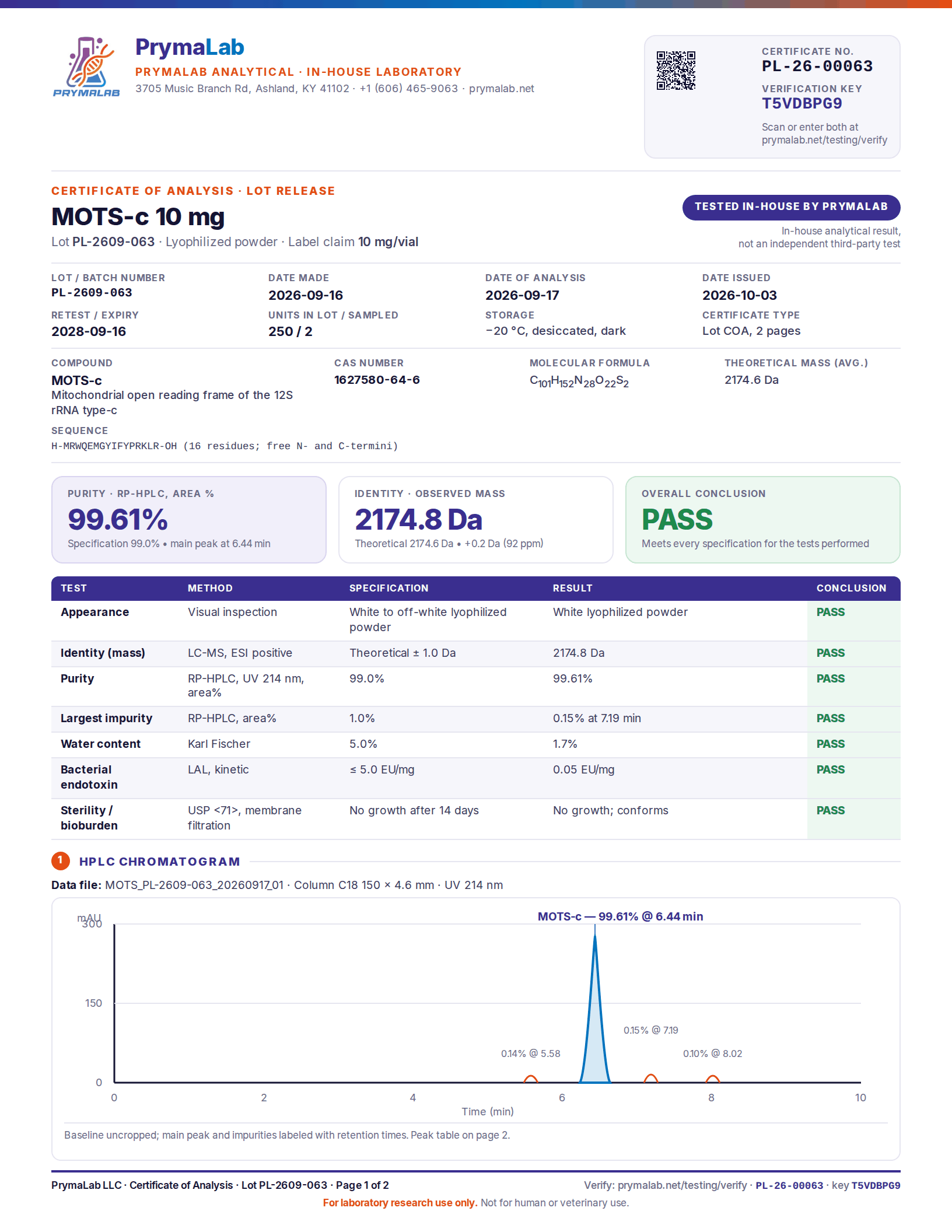
MOTS-C 10 mg vial
Lot: PL-2609-063
Certificate: PL-26-00063
Analysis: September 17, 2026
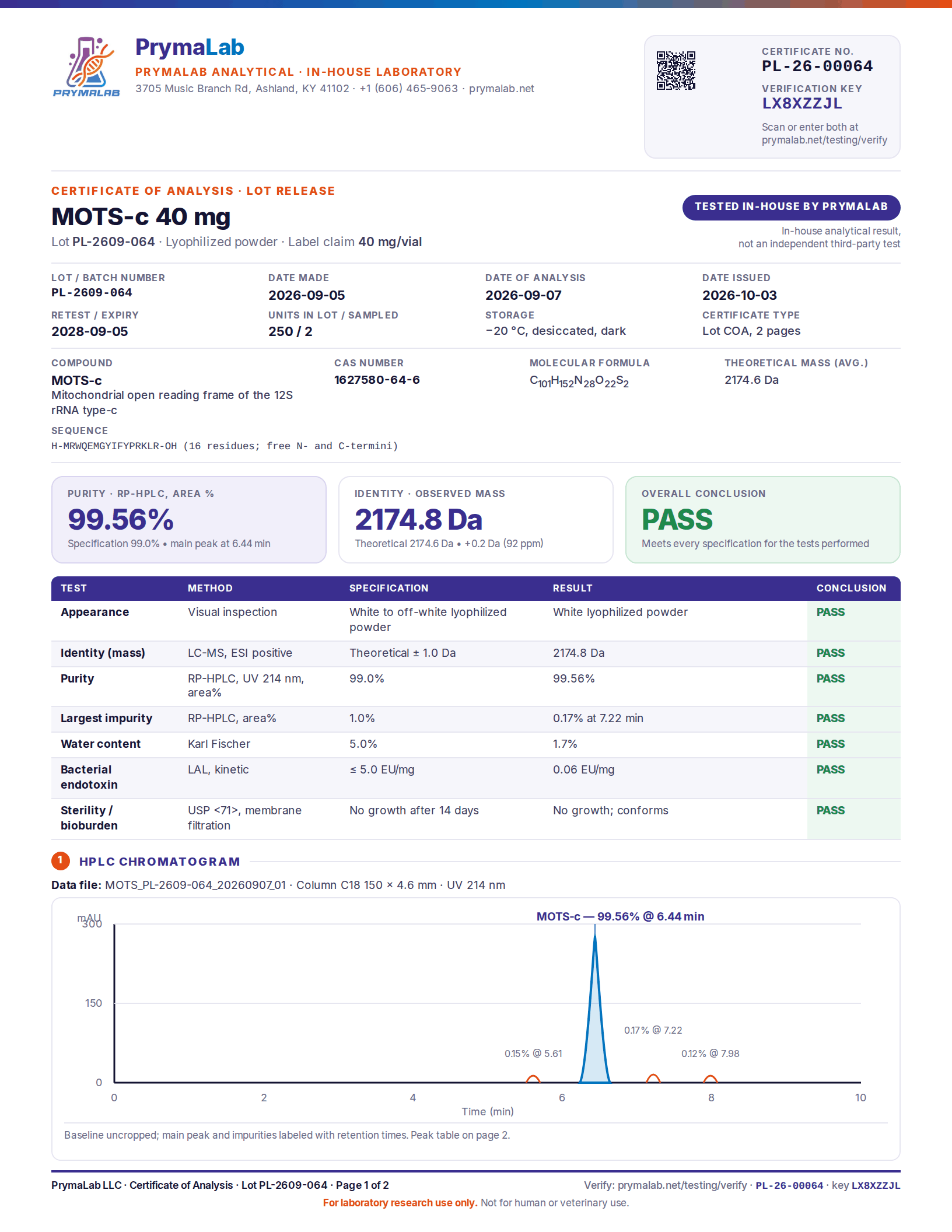
MOTS-C 40 mg vial
Lot: PL-2609-064
Certificate: PL-26-00064
Analysis: September 7, 2026
The reports identify the testing as in-house, with no outside laboratory reports attached. Each lists 250 units in the lot and two units sampled. These details describe the documented sample and testing arrangement.12
What did the laboratory report for each vial lot?
The two certificates include the same test categories. All listed rows carry the laboratory’s PASS conclusion; the exact results are reproduced below.12
| Test / method | 10 mg · PL-2609-063 | 40 mg · PL-2609-064 |
|---|---|---|
| Appearance / visual inspection | White lyophilized powder | White lyophilized powder |
| Identity / LC-MS | 2174.8 Da observed mass | 2174.8 Da observed mass |
| Purity / RP-HPLC, UV 214 nm | 99.61% area | 99.56% area |
| Largest impurity / RP-HPLC | 0.15% at 7.19 min | 0.17% at 7.22 min |
| Water / Karl Fischer | 1.7% | 1.7% |
| Bacterial endotoxin / kinetic LAL | 0.05 EU/mg | 0.06 EU/mg |
| Sterility / bioburden · USP <71> membrane filtration | No growth; conforms | No growth; conforms |
The identity result is compared with a stated theoretical mass of 2174.6 Da and an acceptance range of ±1.0 Da. The reported difference is +0.2 Da. Both chromatograms place the main peak at 6.44 minutes; the individual impurity peaks and their areas appear on page two.12
Read the test names with the results. HPLC purity, water content, endotoxin and sterility are separate measurements. A PASS applies to the stated test and specification for the sampled lot; it does not describe a clinical effect or a finished pen.12
Does 99.61% purity tell you how many milligrams are in the vial?
The percentage and the milligram label answer different questions. The reports calculate purity as the main chromatographic peak area divided by the total integrated peak area. The 10 mg and 40 mg amounts are explicitly identified as label claims.12
- Purity: the stated chromatographic area percentage under the report’s method.
- Quantity: the labelled total peptide amount per vial.
- Concentration: milligrams per millilitre after preparation, or the specification for a preloaded solution.
Neither certificate lists a separate measured peptide-content assay in milligrams per vial. Multiplying the label claim by the HPLC percentage would therefore be a calculation, not a reported content measurement. The 40 mg label means four times the nominal quantity of a 10 mg vial; it does not by itself specify four times the solution concentration.12
How do you match a MOTS-C COA to the vial?
- Match the full lot number. PL-2609-063 belongs to the listed 10 mg vial report; PL-2609-064 belongs to the 40 mg report.
- Check the product and format. Each certificate names lyophilized powder and its vial label claim.
- Read both pages. Page one contains the result summary; page two contains the method, peak table, additional-test records and approvals.
- Keep the certificate number with the lot. The PDFs include the issuing laboratory’s verification details for checking its own record.
If the label shows a different lot, request that lot’s certificate. A report for the same peptide or the same vial size is not automatically the matching record. For a missing file or a document mismatch, send the product name, lot number and relevant page link to [email protected].12
Does a vial COA also cover the MOTS-C autoinjector?
The two PDFs on this page name vial lots. The listed pen specification is 30 mg in 3 mL, which equals 10 mg/mL. A separate certificate for the finished pen is not displayed here.
For the pen, the useful matching records would identify the finished product and lot, its concentration, formulation and device instructions. Milligrams per click require the exact device calibration; 10 mg/mL alone does not supply that setting. Likewise, the pen’s 3 mL volume is not a statement about either powder vial’s capacity.
What storage and retest details appear on the COAs?
Both certificates state −20 °C, desiccated and dark for the documented powder lots. The 10 mg report gives September 16, 2028 in its “retest / expiry” field; the 40 mg report gives September 5, 2028.12
Those entries belong to the named lyophilized lots and the stated storage conditions. They are not an opened-vial discard date or a storage instruction for the preloaded pen. Once a powder is prepared as a solution, its concentration, diluent and preparation-specific storage instructions need to be considered separately.
What else should you check before comparing products?
Are these independent third-party reports?
Does the small purity difference make one vial more effective?
Can I use the COA to choose a dosage or cycle?
A COA records product testing. The dosage, cycles and reconstitution guide separately explains reported routines and concentration arithmetic; the laboratory certificate does not prescribe a schedule.
Where can you view the MOTS-C products?
Compare MOTS-C vials and autoinjector
View the original product images, labelled quantities and format details together on the buying page.
For questions about a file or a batch number, contact the publisher. Read the editorial policy for how product records, research and individual reports are presented.
Sources and original records
The complete original certificates are linked below. Reported values apply to the named vial lots.
- 01Original MOTS-C 10 mg vial certificate · PL-2609-063 ↗
Certificate PL-26-00063. Original two-page in-house report: results, chromatogram, peak table, methods, sample count and approval records.
- 02Original MOTS-C 40 mg vial certificate · PL-2609-064 ↗
Certificate PL-26-00064. Original two-page in-house report: results, chromatogram, peak table, methods, sample count and approval records.